
Demand for high powered tractors revs up 2024 baling season
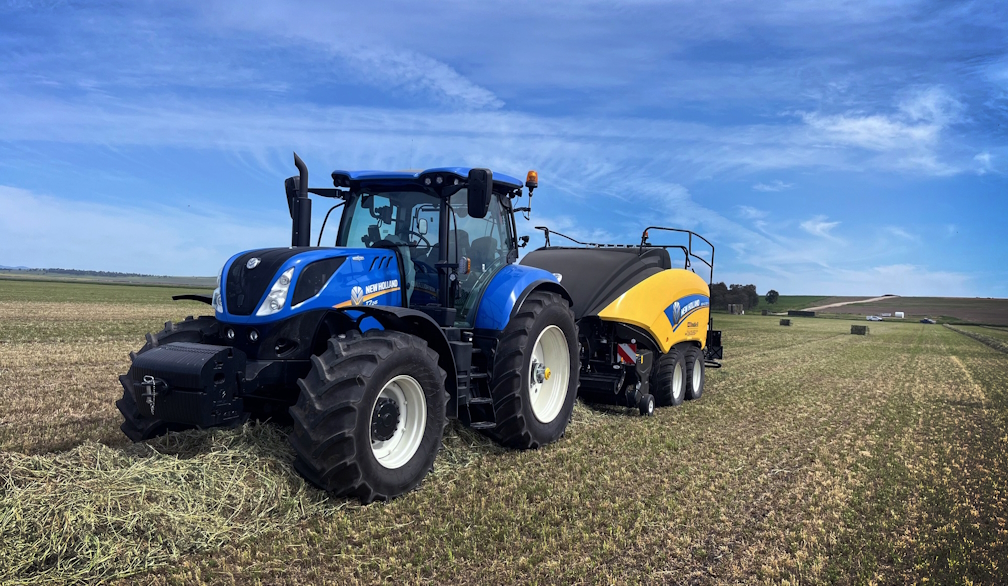
New Holland dealer Double R is seeing increased demand from farmers and contractors for high horsepower tractors to operate machinery and cover more ground in less time.
With a promising season ahead due to above-average rainfall, New Holland dealer Double R has been busy getting farmers and contractors ready in the Tamworth, Gunnedah and Hunter Valley regions for the hay and grain harvest season.
Double R Gunnedah Branch Manager Chris Canham said customers were increasingly turning to high horsepower tractors to manage larger fields and operate equipment like wider planters and high-capacity balers.
“This year, we’ve seen a growing demand for high-powered tractors, as many of our customers’ machines now require more horsepower.
“Farmers are also opting for larger equipment because they have fewer available staff. Twenty or thirty years ago, it was easier to manage smaller machines with a larger workforce.
“Now, they still need to cover the same acreage but must do so more efficiently. So, they’re choosing wider planters and tractors with greater horsepower, especially when using powerful balers and other machinery.
“Many farmers are actively cutting hay with increased activity expected over the next week or two, while the crop yield later this year looks strong,” Chris said.
Baling is currently underway at beef producer Phil Marheine’s property, who has 130 hectares of lucerne and forage sorghum under irrigation at Willow Tree, in the NSW Liverpool Plains.
Due to increased demand this season Phil has purchased a New Holland 1290 Big Square Baler with son Simon Marheine, who operates Sparrow Creek Contracting.
He has also just taken delivery of a New Holland T8 tractor.
Phil said flexibility was the deciding factor when purchasing the 1290 Big Square Baler.
“Simon’s contracting business has grown, and we needed a high-capacity baler with excellent throughput to meet customer demand,” he said.
“Simon does all my baling work. We decided on the 1290 as its easier to stack the big squares in my sheds, and it’s also much easier to load and transport squares than rounds for hay and haylage that we sell that we don’t use ourselves.
“We were already familiar with New Holland square balers as Simon was using the previous model, and little square balers as well.
“We’ve made 790 bales in last five days since taking delivery of the 1290. There really is no comparison in terms of bale weight and throughput.
“It also opens a larger window for baling, as conditions don’t have to be perfect for the 1290 to produce decent bales,” he said.
Phil currently owns four New Holland tractors, including two T5s, a T9 and the new T8.
“The T8 is another step up again, a lot simpler machine to operate. It’s currently got 50 hours on it and has been doing feed mixing work since I got it,” he said.
Phil said Double R had been providing after sales support and ongoing maintenance for his New Holland tractors for the past four years, since he started his own beef and forage operation after 27 years in quarrying.
“Coming from an earth moving background, I really appreciate the service and support Double R provides.
“Double R’s founder Rusty Russell has a mining background, and it certainly shows. He has bought the mining industry ethos across to the service of agricultural machinery.
“They keep in touch and my Product Support Representative will save time by driving out the spare parts saving me a trip into the dealership,” Phil said.
Double R is the Authorised Sales and Service Dealer for New Holland in the Tamworth, Gunnedah, and Hunter Valley regions.
Founded by Diesel Mechanic Rusty Russell in 2005, Double R has grown to around 250 employees. Key products include New Holland high horsepower tractors, round balers, and square balers.
For over 125 years, New Holland has supported farmers with the technology, solutions and services they need for productive agriculture. It has a history of driving innovation, providing the answers to customer needs with a broad range of agricultural and light construction equipment. With proven production machines that utilise the latest alternative fuel technology to power the sustainable revolution in farming, we are the sector’s Clean Energy Leader. Our expertise and innovations are backed by precision connected services and supported by a dedicated and global dealer network with a strong territory presence.
With you, Season after Season.
New Holland is the brand of CNH Industrial N.V. (NYSE: CNHI) a world-class equipment, technology and services company. More information about CNH can be found online at www.cnh.com


